
Training
An intensive 3- to 5-year course based entirely on practical work and projects. There are no specific entry requirements: no qualifications or academic records are required.
Prerequisites
The stages of the selection process
To join 42, you must be over 18 and pass the selection process (online test, check-in and swimming test).
Online Test
Step one: assess cognitive skills using online tests in the form of games. This step is carried out remotely throughout the year, for those aged 18 and over.
Duration: 2 hours
When: All year round
Check in
If you’ve passed the online tests, come to our campus and find out more about our course. Don’t forget to register.
Duration: 1 hour
When: check the student events calendar
Swimming pool
A month-long immersion in our methods to find out if 42 is the right course for you. You’ll get stuck into real tech projects – no programming experience is required, just motivation. This stage takes place on-site only. Places are limited.
Duration: 4 weeks
Where: on campus
Back to school
Welcome to 42, a few weeks after passing the Piscine! You’re starting the Core Curriculum; the start date depends on which Piscine you passed: you can’t change it.
Duration: 12 to 18 months
When: check the student calendar
Sign up for the online tests
Create an account and start the online tests, which are in the form of games. No coding knowledge is required – it’s all about logic. Allow two hours; there are no breaks and you cannot restart.
What is La Piscine?
The Swimming Pool
La Piscine is the selection process for 42 Lausanne. For 26 days, you’ll be immersed in the programme from morning to night. You don’t need any prior coding experience; you’ll learn on the job, by solving real-world problems and asking your peers for help. It’s intense, demanding, and completely free.
The 42 Lausanne Piscine is a unique selection and learning experience designed for those who have passed the online tests and wish to discover software development in real-world conditions.
The Swimming Pool in Figures
2'000
applications per year: 42 in Lausanne
400
people who have used a swimming pool during the year
150–200
students selected each year
Course structure
Course
The 42 programme typically lasts between 3 and 5 years, depending on individual goals and progress.
The course is divided into two parts: the core module and the advanced module.
The core curriculum must be completed within a maximum of two years.
The advanced course may take longer, depending on your career plans.
The overall programme comprises two work placements (one lasting 4 to 6 months and the other 6 months).

« The stages of the course »
As a student at 42, you start with simple projects to learn the basics of programming, then move on to a wide variety of real-world projects, either in a team or on your own. The aim: to become a well-rounded junior programmer, ready for the job market.
The Core Curriculum provides you with a solid and comprehensive foundation, combining technical and soft skills.
Duration: 6 to 24 months (maximum 24 months).
You will learn to
Program in C, Python and other languages.
Use classic algorithms.
Explore UNIX file systems and processes.
Understand network architecture and system administration.
Discover object-oriented programming.
Develop client-server projects.
After completing the core curriculum, many students choose to undertake their first work placement. This is not compulsory, but it is strongly recommended.
Objectives:
Apply your skills in the real world.
Understand professional tools and methods.
Clarify your future career path.
Students on the advanced programme can code in C++ and specialise in the areas that interest them most. This stage is designed to bring them up to a level equivalent to a Master’s degree in Computer Science.
Duration: up to 5 years (flexible pace).
How it works: Each completed project unlocks access to further projects and other areas of coding and computer science. This makes each student’s journey unique, whilst ensuring a common foundation.
Career integration & recognition:
During the advanced programme, many students reach a level that already enables them to secure a job.
Flexibility:
You are not obliged to limit yourself to a single specialisation or to complete it in full.
You can explore different areas and choose projects that align with your goals.
International mobility:
This phase can be undertaken not only in Lausanne or Zurich, but also at any 42 campus worldwide, thanks to the common curriculum.
Students undertaking a second placement gain professional experience that is generally longer and more specialised. Around 98% of students who have completed the advanced programme already have a job lined up before the end of their course. This second placement is required to obtain RNCP qualifications.
Objectives:
To apply advanced skills in a practical setting.
To strengthen expertise and specialisation.
Turn experience into opportunity (many placements at this stage lead to a job).
Certificate 42 can be awarded upon completion of the core curriculum
It is possible to obtain certifications (RNCP levels 6 & 7), giving access to a professional qualification recognised throughout Europe, provided the necessary work placements have been completed.
It is possible to sit the Federal Certificate in Computer Science, Application Development Specialist option
Course structure
Work placements
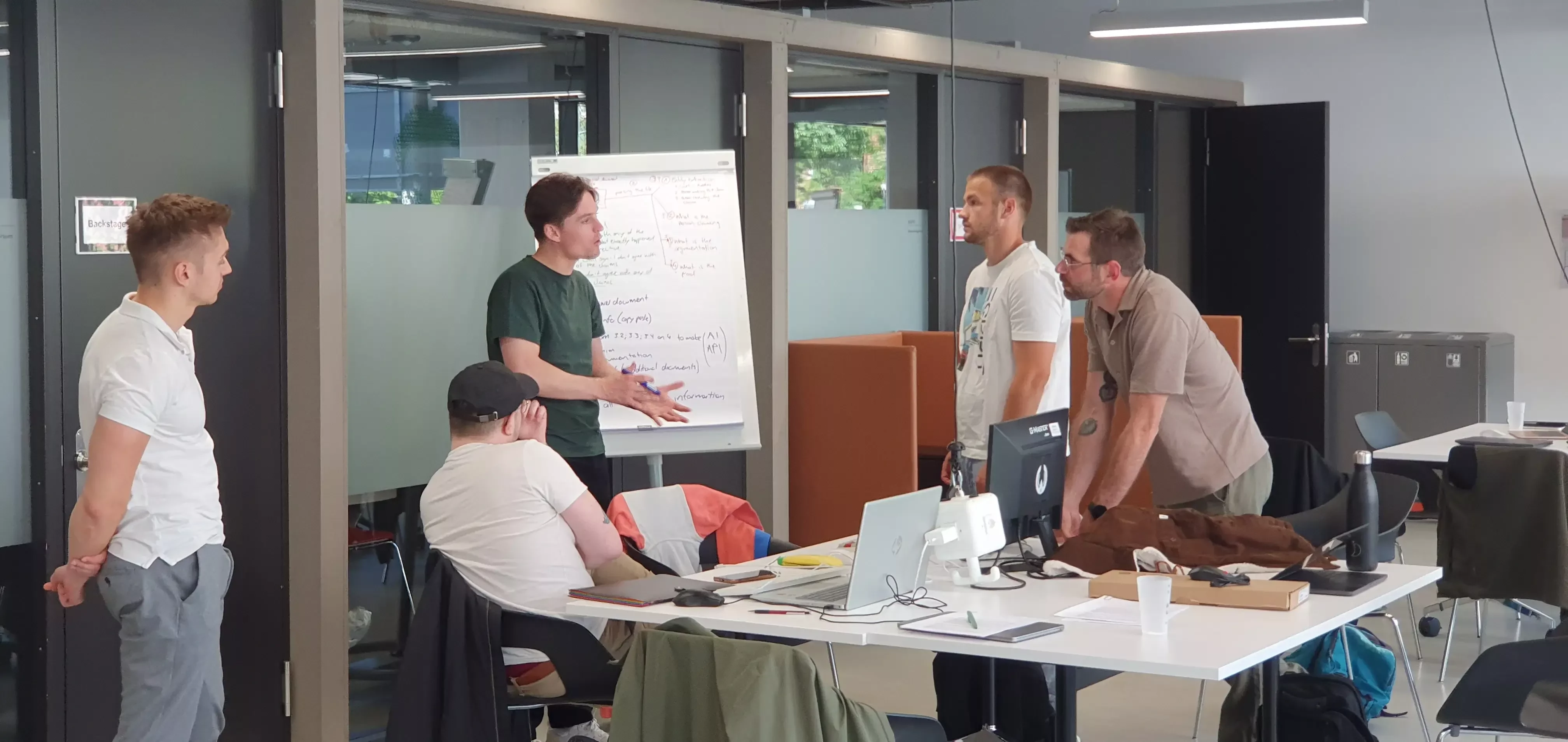
At 42 Lausanne, the work placement forms an integral part of the training programme. As a compulsory component of the curriculum, treated as a project in its own right, it enables students to apply their skills in a real-world professional environment, gain technical, organisational and interpersonal experience, and gain a better understanding of the practical challenges faced by businesses.
The internship lasts between 4 and 6 months on a full-time basis and can take place at the end of the core curriculum or upon completion of the specialisation programme. It is assessed by both the host company and the student’s peers, in accordance with the educational principles of 42 Lausanne.
For the placement to be valid, the student must obtain an employment contract from their future employer, and the company must receive the student’s 42 placement agreement. The placement must be paid in order to be recognised by 42 Lausanne.
Skills
Subjects covered in the Core Curriculum
Algorithms
Designing efficient algorithms, exploring graph theory.
System administration
Install, secure and manage a server infrastructure.
artificial intelligence
Understanding and using LLMs, building RAG systems and AI agents.
Basic programming
Mastering C from the basics: libraries, memory management, algorithms.
Object-oriented programming (Python)
Master Python and OOP through practical and creative projects.
System and network programming
Concurrency, threads, network protocols, advanced data structures.
Skills
Topics covered in the Advanced Course
Algorithms and Mathematics
Linear algebra, advanced data structures, competition problems. For students with an analytical background.
Cybersecurity
Vulnerabilities, reverse engineering, exploitation, CTF. One of the most sought-after specialisations on the Swiss market.
Mobile Development
iOS and Android apps, API integration, mobile interface design.
Web development
Front-end, back-end, APIs, real-time applications, modern frameworks. The field most sought-after by recruiters in French-speaking Switzerland
DevOps / Cloud
Kubernetes, CI/CD, cloud infrastructure, provisioning. Key skills for businesses that have moved to the cloud.
AI and Machine Learning
Gradient descent, neural networks, implementation of ML models. For those who want to go beyond simply using LLMs.
Graphics and Virtual Reality
OpenGL, game engines, Unity projects, VR. For creative and technical roles.
Kernel and low-level
Operating systems, assembly language, C or C++ projects. For infrastructure enthusiasts.
Degrees and certifications
Certificate 42, awarded upon completion of the core curriculum
The titles IT Solutions Designer and Developer and IT Architecture Specialist if you take the related modules
42 Lausanne is also preparing for Federal Certificate in IT, Application Development Specialist role.
Frequently Asked Questions
Do you have any questions? Take a look at our FAQs – we’ve listed the most common ones there.