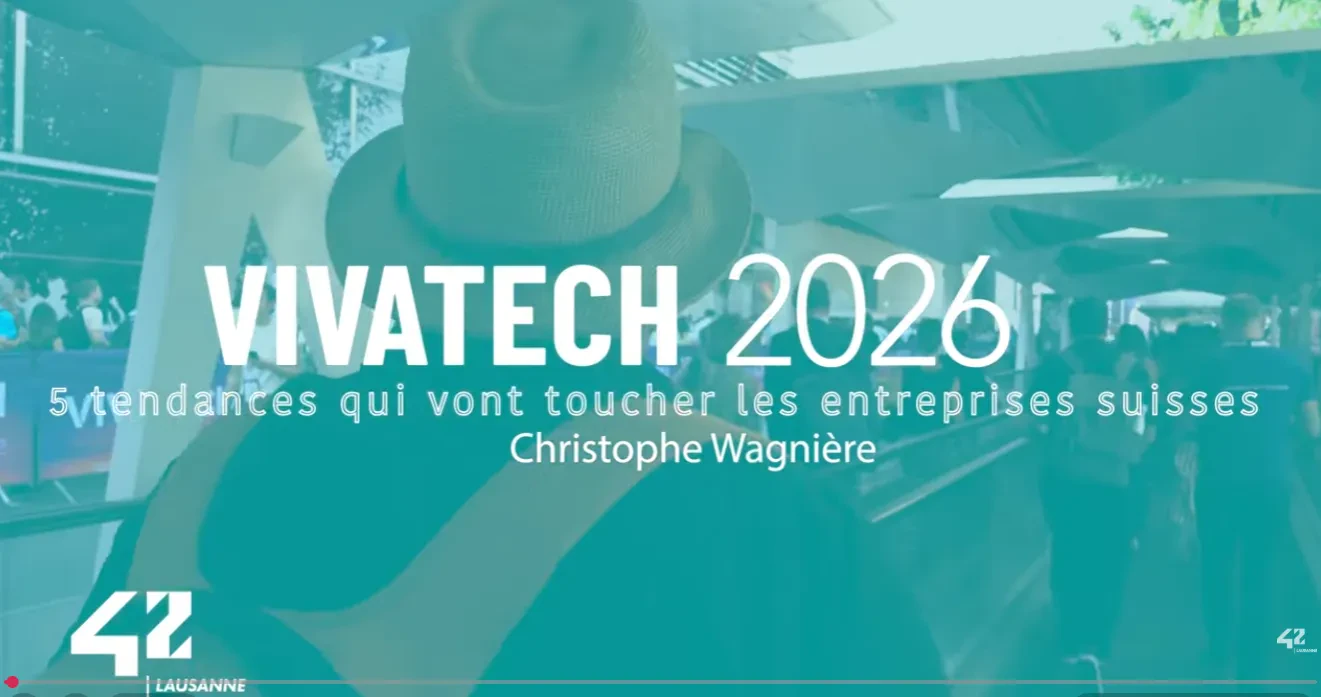
VivaTech 2026: 42 Lausanne shares five key innovation trends
With over 100,000 visitors a day, thousands of start-ups and the world’s leading tech companies, VivaTech 2026 is a showcase for global innovation. 42 Lausanne was there to distinguish between hype and genuine trends. Here are the five innovations that could have the greatest impact on Swiss businesses.
1. Humanoid robotics is no longer just a trade fair gimmick
Dancing robots have caused a stir on social media, but behind the spectacle, a real shift in scale is taking place. “What really struck me were the humanoids. For the first time, I’m starting to see robots that dance better than me, move better than me, and almost speak better than me,” says Ivan Mariblanca Flinch, CEO of Mikujy.
Ramzi Bouzerda, CEO of Droople, sees this as a structural shift rather than a passing fad: “Robotics has taken on enormous significance at this trade fair because it’s the combination of AI and human capability, so we’re now talking a lot about ‘augmented humans’.” ” For Olga Guerous, CEO of Innopearl, the trajectory is clear: robotics “is beginning to take on a more human form […] increasingly in the personal care sector”.
2. Generative AI, yes but not the kind we think
Whilst artificial intelligence is everywhere at the exhibition, the real issue isn’t the consumer-facing tools that everyone is already familiar with. “Most companies don’t know what to do and aren’t aware of the use cases and potential of generative AI,” observes Frédéric Soulier, co-founder of Quantalogic. A view shared by Olga Guerous: “It’s not so much the ChatGPT version of AI […] it’s AI designed to tackle the various challenges that any business faces.”
This shift requires a genuine change in mindset within organisations. Caroline Porot, director of 42 Mulhouse, has seen this first-hand in the field of training: “We’ve launched a training course for professionals in generative AI, and the market is huge.”
3. Health Tech: the surprise hit of the show
No one expected it to reach this level: cosmetics, wellbeing, personalisation through AI – major groups such as L’Oréal and LVMH are investing heavily in the sector. “When you see what’s happening in health tech and medtech, it’s actually quite mind-blowing,” notes Olga Guerous. Ivan Mariblanca Flinch was struck by an app capable of “detecting consumers’ emotions via a wristband […] to understand why the customer is buying”. A glimpse of what personalisation through data is already making possible.
4. Cybersecurity: everywhere and nowhere at the same time
This is undoubtedly the most counter-intuitive trend: cybersecurity doesn’t have its own giant pavilion, and yet it permeates every conversation. Simon Thomé, co-founder and CPO of Aurigin.ai, illustrates the urgency with a figure that really hits home: “It takes just 20 seconds of a CEO’s interview found on YouTube to replicate their voice in a hyper-realistic way.”
Fabien Kunzler, Swiss director of Sharekey, advocates a different approach to that of the cloud giants: “The keys remain on your device […] compared to all the big tech firms, where the key is often jointly owned, the cloud can be hacked.” ” This observation is well summarised by Cécile Maye, Vice-President of Swiss Aware: “Everything is a bit tangled up together”; cybersecurity is no longer a separate issue, it has become a cross-cutting aspect of all tech projects.
5. A new wave of innovation, driven by start-ups
One final observation, perhaps the most significant: VivaTech confirms a genuine resurgence of entrepreneurial energy, fuelled by AI. Ramzi Bouzerda, attending the event for the fifth time, notes a clear shift in scale: “It used to be very much a French affair, but now it’s become truly international.” For Olga Guerous, the message to businesses is unambiguous: “Companies have realised that there can be no growth without innovation.”
Trends, but what next?
Five trends, one common denominator: none of them creates value on its own. We need people capable of understanding them, testing them, adapting them and rolling them out in a real business context. This is precisely the question Christophe Wagnière put to Caroline Porot, director of 42 Mulhouse: will Switzerland need more or fewer tech specialists in the years to come? Her response: “We’ll need just as many, but with completely different skills. And that’s where, at 42, I believe we’re really one step ahead […] with highly versatile people who are capable of constantly learning and adapting.”
Stéphane Maisons, head of 42 Spain, perhaps best sums up what 42 is trying to cultivate: “I think 42 is the Swiss Army knife of technology and innovation. Quite clearly.”
This article accompanies the first video in a series of five dedicated to 42 Lausanne’s presence at VivaTech 2026. The next video will tackle an even more strategic topic: digital sovereignty, and why it’s not just about infrastructure, but also about skills.
Watch the interview video on our YouTube channel and follow us on LinkedIn so you don’t miss out on what’s coming next.